What Is an AI Workforce? The Definition, the Test, and What It Replaces
A definition worth writing down: an AI workforce is a set of AI agents that owns business outcomes end to end, works across every channel a customer uses including the telephone, operates inside explicit rules a human wrote, and reports its results in the same metrics a human team would. Each clause in that sentence excludes something the market keeps mislabeling.
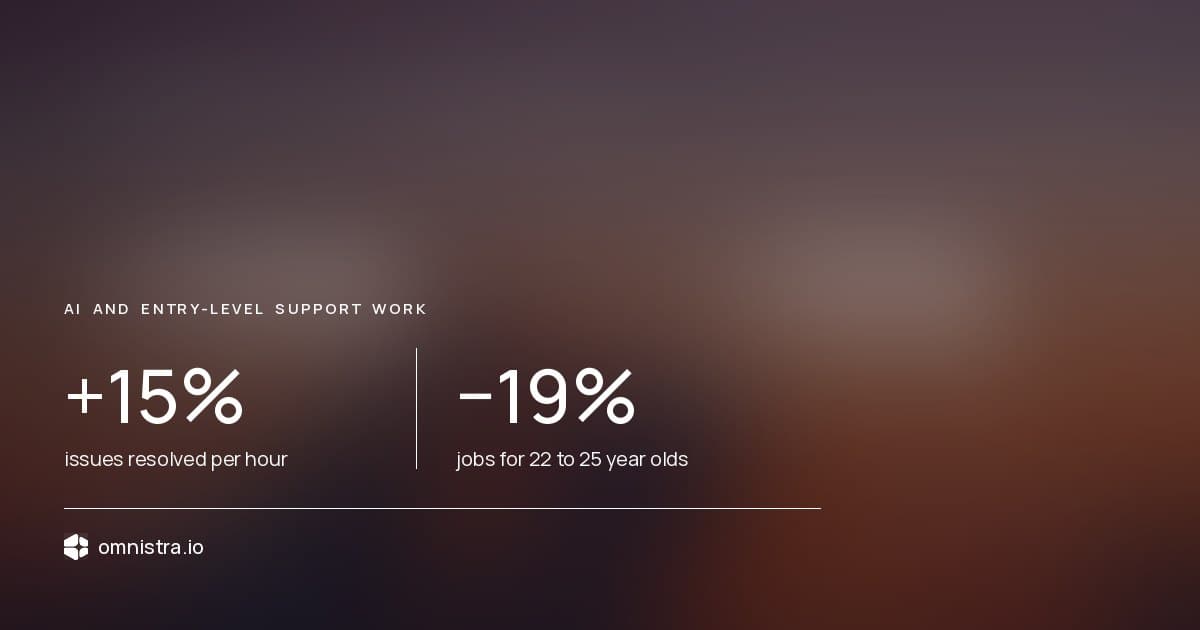
The category matters because the numbers behind it are no longer speculative. Gartner projects that agentic AI will autonomously resolve 80 percent of common customer service issues by 2029, cutting operational costs by 30 percent. Klarna's assistant did the work of 700 full-time agents in its first month. McKinsey values generative AI in customer care at 30 to 45 percent of current function costs. The question for an operator is no longer whether this class of system works. It is how to tell a workforce from a widget.
What it replaces, and what it does not
An AI workforce replaces headcount-shaped work: the roster math of covering 168 hours a week with humans who work 48, the ramp time of a new hire, the attrition that resets it. It does not replace judgment. Every credible deployment on record, Klarna's included, pairs autonomous handling of the routine majority with deliberate human escalation, and Klarna's public correction in 2025, rehiring people for judgment calls, is the honest version of the pattern. A vendor claiming full autonomy is describing a demo, not an operation.
It also does not replace the systems a business already runs. A workforce plugs into them: the store platform where orders live, the helpdesk where a support team works, the courier networks that move parcels. The economics only compound when the agent that answers the question can also act on the order behind it. Answering where is my parcel is a sentence; rebooking the failed delivery is an outcome.
The five-question test
First: does it own outcomes or just conversations? Ask what happens after the reply, whether the system can confirm an order, book a courier, or schedule a callback without a human touching it. Second: does it work the telephone? Voice is the hardest channel and the one that reaches every customer, and most of the market quietly does not offer it. Third: is it governed? There should be an explicit, inspectable workflow that defines what agents may do, not a prompt and a prayer. Fourth: is it measured like a team? Containment rate, first response time, cost per resolution, customer satisfaction, reported continuously, not claimed in a sales deck.
Fifth: is every conversation accountable? A workforce produces evidence: conversations classified against a taxonomy, analyzed after they end, tracked for emotional trajectory while they happen so a turning conversation escalates before it becomes a complaint. If the answer to any of the five is no, the product may still be useful. It is not a workforce.
Where Omnistra sits in the definition
Omnistra was built to pass its own test, and the platform is the argument: voice and messaging agents conversing in more than 60 languages with Bangla and English native, a visual workflow engine governing every action, a hundred-plus-tag classification taxonomy feeding post-call analytics, live emotion tracking on active conversations, and an order operations layer that confirms cash-on-delivery orders, routes couriers and recovers failed deliveries. It integrates with Shopify and WooCommerce and connects to Zendesk, Intercom and Salesforce, because a workforce joins the systems a business already trusts.
Built in Dhaka, fluent in Bangla and 60+ languages, and deployed for customer service, omnichannel support and outbound sales campaigns, Omnistra runs the conversations most platforms leave manual. The definition above is the standard we ask buyers to hold us to, in a live demonstration on their own inbox, in their customers' own language.