How a Bangla Voice AI Takes an Order Call
In natural conversation, humans respond about 200 milliseconds after the other person stops talking. The Max Planck Institute's research adds the uncomfortable detail: we need at least 600 milliseconds just to plan a single word. The only way the math works is that people compose their reply while still listening. Any machine that wants to hold a phone call is racing that standard, in every language, on every turn.
Now add Bangla. It is the seventh-largest language on Earth, roughly 285 million speakers by Ethnologue's 2025 count, and one of the most under-resourced in speech AI. This is the gap Omnistra chose to build in, and this is what the problem actually looks like from inside.
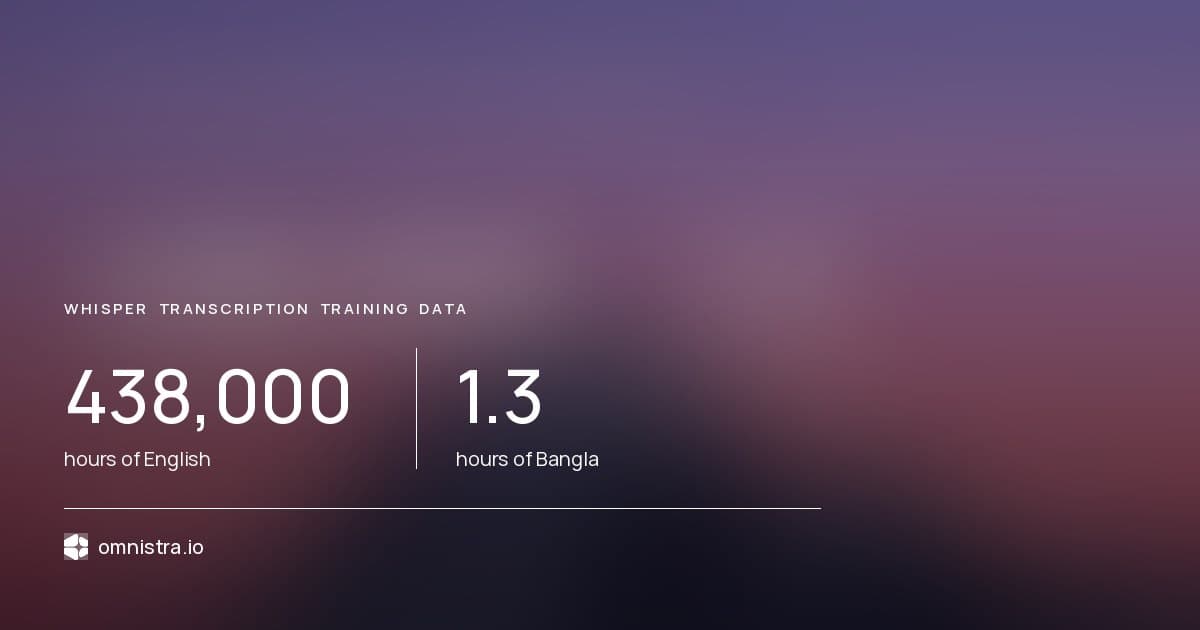
Seventh-largest language, thousandth of the data
The largest public Bengali speech corpus, Bengali.AI's OOD-Speech, holds about 1,178 hours of training audio. English systems train on hundreds of thousands of hours. The consequences show up in the benchmarks: a 2025 study found Whisper Large-v2 transcribing Bangla at a 28.9% word error rate, while a smaller model fine-tuned on Bangla cut that to 14.4%. Fine-tuning beats raw scale on this language, which means a default multilingual API is the wrong starting point for a Dhaka phone line.
Code-switching makes it structural. Real commerce speech here is Banglish, Bangla and English mixed mid-sentence, and even in research challenges with dedicated code-switched training data, error rates on mixed speech stayed stubbornly high. The recognition layer has to be trained for how customers actually order, not how textbooks read. Voice synthesis arrived even later: the first Bangla speaker-adaptive TTS framework was published in April 2025.
The parts of a call that decide the order
Numbers are the highest-stakes seconds of any commerce call, because addresses and phone digits decide whether a parcel arrives. Omnistra's voice agents read critical details back and ask for confirmation, the way a careful human caller does. Understanding is the entry fee; the agent also carries your catalog, delivery zones and policies, and follows an explicit conversation workflow, so an order confirmation cannot drift into an improvised refund negotiation.
And it has to know what it does not know. When a caller asks something outside the brief, the agent says so and hands the conversation to a human with full context, rather than inventing an answer on your brand's behalf.
Latency is the product
Cross-linguistic research puts conversational turn gaps within a band of about a quarter second in every culture studied. Miss that rhythm and callers talk over the agent or hang up. We treat the reply gap as an engineering budget, measured on every production call at the 50th, 95th and 99th percentile, and tuned for the compressed, noisy phone lines calls actually traverse in Bangladesh.
The voice matters less than the rhythm: a natural pause, a readback in the customer's own phrasing, the patience to be interrupted. That is what makes a caller treat the agent as help rather than a machine to escape, and it is why we publish latency to our customers instead of hiding it.