Why Bangla Speech Recognition Fails on Phone Calls
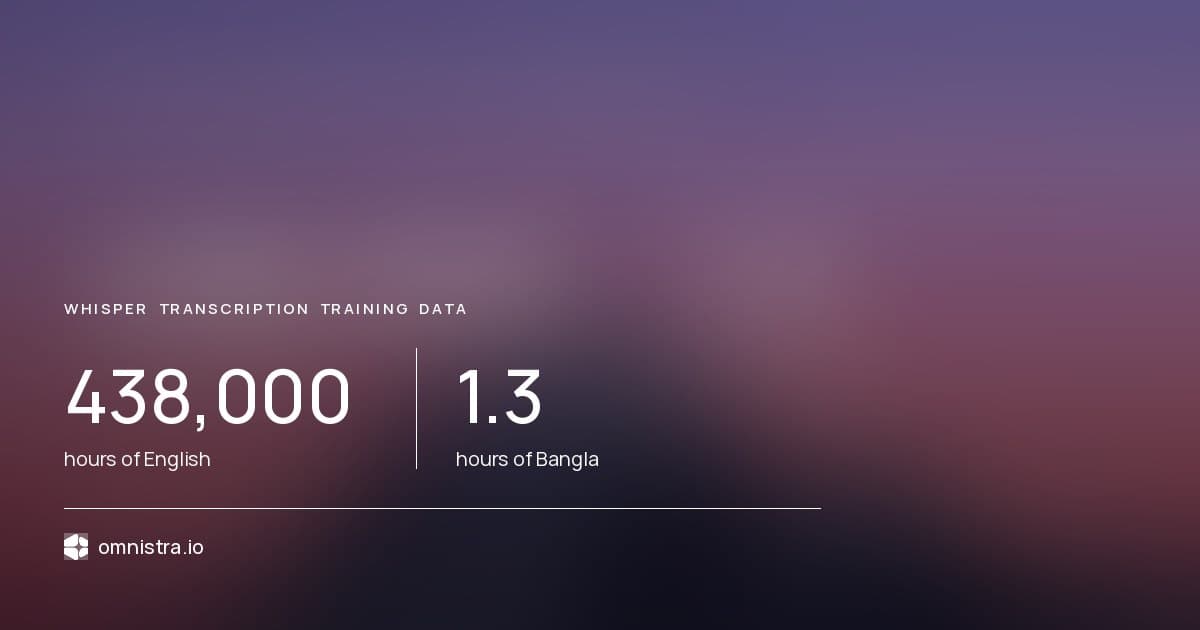
There are over 230 million Bengali speakers. When OpenAI trained Whisper, which is still where most speech pipelines in the world start, Appendix E of the paper records the Bengali transcription training data at about 1.3 hours. Not 1.3 thousand. One point three.
The same appendix shows close to 2,000 hours of Bengali audio used for translation into English. So the model got taught, at reasonable scale, to turn Bangla into English. It got taught, at almost no scale, to write down what a Bangla speaker said. That tells you what the field thought the language was for.
I lead engineering at a company building Bangla voice agents. Three things broke here in ways the literature did not prepare me for. None are model-quality problems, which is the useful part. They are fixable by people who are not training foundation models.
Does Google Cloud offer a Bengali telephony speech model?
No. And it matters more than you would think.
Speech vendors ship separate models for phone audio. Telephony is narrowband, usually 8 kHz, heavily compressed, acoustically nothing like the wideband audio a general model trains on. Running a wideband model on narrowband input is a well-documented and severe mismatch.
So check what is on offer. As of August 2026, Google Cloud Speech-to-Text lists bn-BD across chirp_2, chirp_3, long and short, depending on region. It does not list telephony. It does not list telephony_short. Neither exists for Bengali anywhere.
| Capability | English | Hindi | Bangla |
|---|---|---|---|
| Telephony-tuned ASR model (Google Cloud STT) | Yes | Yes | No |
| Semantic turn detector (LiveKit, as of Aug 2026) | Yes | Yes | No |
| Whisper transcription training data (Appendix E) | About 438,000 hrs | About 12 hrs | About 1.3 hrs |
Every Bangla phone call on that stack is a bandwidth mismatch by construction. Not by misconfiguration. There is no correct setting to pick.
Which changes where you spend. If a telephony model existed, you would use it. It does not. So the work moves upstream, into the audio pipeline, before the recogniser sees the signal. Budget for it as engineering, not as a config flag.
Why does turn detection fail in Bangla?
The hardest part of a voice agent is not understanding words. It is knowing when the person stopped talking.
Good implementations use a semantic turn detector: a small model reading the partial transcript, predicting whether the sentence is finished. LiveKit's, one of the most widely deployed, supports 14 languages as of August 2026. Hindi is one. Bangla is not.
Without one you fall back to silence timers. Wait some number of milliseconds of quiet, assume they are done. We started at 800ms, a common default. That adds most of a second to every turn. Over a five-minute call it is the difference between a conversation and an interrogation. Shorten it and you cut people off mid-sentence.
Then the linguistics, which is where it gets specific. Bangla is verb-final. The verb, and very often the whole meaning, arrives last. Compare Amar order ta cancel with Amar order ta cancel korbo na. One final word apart. Opposite meanings.
A partial transcript in Bangla looks finished long before it is, far more often than English does. So the silence-timer fallback is not just slower here. It fails in a language-specific direction, and that direction is interrupting your customer while they tell you what they want.
I have not found a published Bangla semantic turn detector. If one exists, tell me.
Why are echo and first-call latency the same bug?
This cost me about a week. Saving you the same.
Symptom one: echo persistence. The agent hearing itself, reacting to its own voice. Symptom two: first-call latency, the opening turn noticeably worse than the rest. Two tickets. I worked them separately for days. Same bug.
Acoustic echo cancellation is adaptive. It needs a few seconds of audio to converge on the line. Your greeting plays inside that window. So echo is worst exactly when the agent first speaks, the recogniser transcribes the agent's own greeting as caller speech, and the system either answers itself or burns time throwing away a turn that never happened.
Seen as one problem, the fix is mostly sequencing. What plays during convergence. When the recogniser goes live relative to the output stream. Releasing the turn lock on stream completion rather than on a timer. We shipped that and both symptoms went with it. Seen as two problems, you have two people chasing two symptoms of one cause.
Why does identity resolution come first in a Bangla-script market?
The last one, and it is not a speech problem at all.
A customer calls about an order. The agent needs their history, so it looks them up. Except in Bangladesh one person is routinely several records. Swapnil. Sopnil. Swopnil. And the same name again in Bangla script. One human, four spellings, entered by four different people across four orders, two scripts, and no transliteration standard anywhere in this market.
Exact string matching returns a partial history and no error. That is the worst way for a system to break, because it is confident and it is wrong. The agent tells someone it cannot find their previous order. Everything downstream then gets computed on a fragment: the risk decision, the routing, the tone of the whole conversation.
So identity resolution in a Bangla-script market cannot be a string comparison. It needs a phonetic layer and a confidence score. And it has to exist before anything that reads customer history, because retrofitting means recomputing every decision already made.
That is a design rule rather than a finding. But I have not seen it written down for this market, and I would have liked to read it before I started.
What the three gaps have in common
Infrastructure gaps, not intelligence gaps. No telephony model. No turn detector. No transliteration standard. The models are not the constraint here. The scaffolding that exists for English, and increasingly for Hindi, has not been built for Bangla.
That is a better position than it sounds, because none of it needs a frontier lab. It needs someone obliged to make Bangla phone calls work.
If you are building on Bangla speech and hit any of these, or solved them differently, I want to hear it. Very little is written about this and most of what exists is about Hindi.
About the author
Samiul Sakib is a co-founder and Chief Technology Officer of Omnistra Private Limited, Dhaka, which builds Bangla and English voice and messaging agents and Order OS for cash-on-delivery commerce.